2026 ARCHITECT PREPARATION PLATFORM6,570+ SCENARIOS

Lakehouse Architecture & Systems MasteryEnterprise Blueprints, Medallion Patterns & Principal Systems Practice

The premier open-access knowledge base for Lakehouse Architects and Lead Data Engineers. Master modern Lakehouse Architecture, Medallion patterns, Microsoft Fabric OneLake, Databricks Delta Lake, Apache Spark 4.0, Iceberg, and distributed systems design.

7,080+ Questions
3,206+ Scenarios
32 Blueprints
21 Subpages Across 8 Hubs
100% Free & Open Access
Core Study Pillars

Choose Your Architectural Focus

1. Concepts & Foundations

660+ Concepts · Mind Map

Comprehensive architectural glossaries, visual hierarchy taxonomy depth tree, and core lakehouse engine concepts.

Concepts Glossary (660+ Terms)
Interactive Mind Map Tree
Delta Lake vs Iceberg Internals
Modern Stack Core Concepts

2. Architecture & Systems

3,206+ Scenarios · Spark Lab

Real-world enterprise system design problems, Spark physical execution & Tungsten lab, DataOps lifecycle, and Cloud × Table Matrix.

System Design Scenarios
Spark Engine & Tungsten Lab
DataOps Lifecycle Playbook
Cloud × Table Matrix

3. Coding & Runbooks

69 Runbooks · 164 Drills

Production incident playbooks, Databricks cheat sheets, P0 outage cheat codes, and runnable PySpark, SQL, and Polars drills.

Sev-1 Incident Runbooks
Databricks Cheat Sheets & PDFs
PySpark & Spark SQL Drills
Polars Rust Vectorized Code

4. Visual Blueprints & Diagrams

32 Whiteboards · Interactive Flows

Hand-drawn whiteboard architectural diagrams, system design workflows, and interactive end-to-end data pipeline flow SVGs.

32 Whiteboard Architecture Blueprints
Interactive DataOps Pipeline SVG
Modern Stack Visual Flow Canvas
Spark Memory & Shuffling Sketches

5. Interview Drill Hub

7,080+ Qs · 156 Targets

Interactive SM-2 spaced repetition question drill, domain question banks, and verified Tier-1 GCC / BigTech hiring playbooks.

7,080+ Vetted Interview Q&As
156+ Target Enterprise Profiles
Interactive SM-2 Flashcards
Architect Scenario Defenses

6. Learning Journey

12 Curricula · 13 Tracks

Structured tech tracks and week-by-week role curricula from Fabric DP-600 to 32-Week Principal Lakehouse Mastery.

Guided Tech Topics
12 Career Roadmaps
Milestone Checklists
Multi-Hop Learning Plan
Platform Release Radar

What's New: Recent Platform Enhancements

Oct 2026 Production Build•100% Operational
Navigation Architecture

Always-Visible Universal Navigation

Permanent access across all layouts with zero hidden menus

Engineered a responsive dual-tier top navigation ribbon, an always-expanded desktop sidebar tree with branch guides, and an all-subpages mobile drawer. All 8 hubs and 21 subpages are now permanently visible on mobile, tablet, and desktop.

Top horizontal subpage ribbon with auto-centering
Always-expanded desktop sidebar with 21 subpages
No hidden menus on mobile or tablet
Full multi-column sitemap footer
CI/CD & Governance

DataOps & CI/CD Lifecycle Hub

Tool connectivity, secrets management & 5-stage project playbook

Launched a complete 4-module DataOps portal covering tool secrets and authentication (ADF, Databricks, Fabric, Key Vault, Managed Identities), CI/CD alternatives (DABs, Git-Sync, Slim CI), an end-to-end 5-stage project lifecycle playbook, and whiteboard flow diagrams.

8 Tool connectivity & Managed Identity guides
7 CI/CD tool comparisons (DABs vs Terraform)
5-Stage project lifecycle deliverable checklist
Interactive digital whiteboard architecture flow
System Design

32 Production Whiteboard Blueprints

Hand-drawn digital whiteboard sketch architecture diagrams

Curated 32 authoritative architectural blueprints following digital whiteboard sketch design standards: Fabric OneLake, Direct Lake VertiPaq, Airflow, Spark AQE, Delta Lake ACID mechanics, Unity Catalog, Purview, Kimball Star Schema, and Enterprise Data Mesh.

32 High-resolution digital whiteboard visuals
Semantic color coding (Compute, Data, Storage)
Control flow vs data flow arrow differentiation
Deep-dive technical architectural explanations
Core Engines

Spark 4.0 Physical Execution & FinOps

Catalyst optimization, Tungsten memory & cloud cost governance

Expanded the core engine simulators with Apache Spark 4.0 physical DAG planning, Tungsten memory allocation models, Photon vectorized C++ execution benchmarks, and cloud FinOps lakehouse cost reduction playbooks.

Tungsten on-heap/off-heap memory calculator
Adaptive Query Execution (AQE) skew handling
Delta vs Iceberg open table format benchmarks
FinOps SKU sizing & capacity unit formulas
Interview Practice

6,570+ Verified Q&As & Company Intel

SM-2 spaced repetition flashcards & BigTech hiring dossiers

Enhanced the interview drill bank with SM-2 spaced repetition flashcards mode, detailed architectural defense rubrics, and targeted interview intel dossiers for Microsoft, Amazon, Google, Meta, Apple, Uber, Walmart, and Tier-1 GCC enterprises.

6,570+ Architect-level technical scenarios
Interactive SM-2 spaced repetition flashcards
6 Tier-1 GCC enterprise hiring dossiers
Instant bookmarking and review studio
Full Content Architecture

Complete Curriculum & Platform Sitemap Matrix

Every subpage is continuously accessible, verified against Microsoft Fabric and modern lakehouse standards.

Cloud × Table Matrix
Multiple Tracks
Hub

Core architectural curriculum and exercises.

Architecture Scenarios
3,206+ Scenarios · Spark Lab
Principal

Real-world system design scenarios, Spark Tungsten memory simulator, DataOps lifecycle, and Cloud × Table Matrix.

Spark Engine Lab
Multiple Tracks
Hub

Core architectural curriculum and exercises.

DataOps & CI/CD
4 Modules · 5 Stages
CI/CD & E2E

Tool connectivity & secrets, CI/CD pipelines, end-to-end lifecycle playbook, and architecture flow.

Concepts Glossary
660+ Concepts · Mind Map
Foundations

Architectural glossaries, visual hierarchy taxonomy depth tree, and core modern lakehouse engine concepts.

Concepts Mind Map
Multiple Tracks
Hub

Core architectural curriculum and exercises.

Code Practice
69 Runbooks · 164 Drills
Prod Ready

Severity-1 incident playbooks, Databricks cheat sheets, and runnable PySpark, SQL, and Polars drills.

Cheat Sheets
Multiple Tracks
Hub

Core architectural curriculum and exercises.

Question Drill Bank
7,080+ Q&As · 156 Targets
7.1k+ Qs

Vetted question banks with SM-2 spaced repetition flashcards and Tier-1 GCC company intel dossiers.

Target Company Intel
Multiple Tracks
Hub

Core architectural curriculum and exercises.

Guided Learning
12 Curricula · 13 Tracks
Roadmap

Guided tech tracks and week-by-week role roadmaps from DP-600 to Principal Lakehouse Architect.

Career Curricula
Multiple Tracks
Hub

Core architectural curriculum and exercises.

Worker Deployments
Multiple Tracks
Hub

Core architectural curriculum and exercises.

Study Command Center

Resume Your Learning Momentum

Polyglot Code Hub

PySpark Transformations & Medallion Architecture

Milestone Mastery15%
42 questions & scenarios mastered

Data Architect Pro Tip

Click for next

Use Delta Lake's OPTIMIZE command with Z-ORDER to group related information in the same set of files, speeding up queries.

21 Architecture Whiteboards

Executive Whiteboard Architecture Blueprints

High-resolution whiteboard schematics illustrating distributed compute execution, storage layouts, and enterprise multi-engine lakehouses.

All 21 Blueprints
Fabric & Power BIBlueprint #1 of 21
Guided Track: Microsoft Fabric →

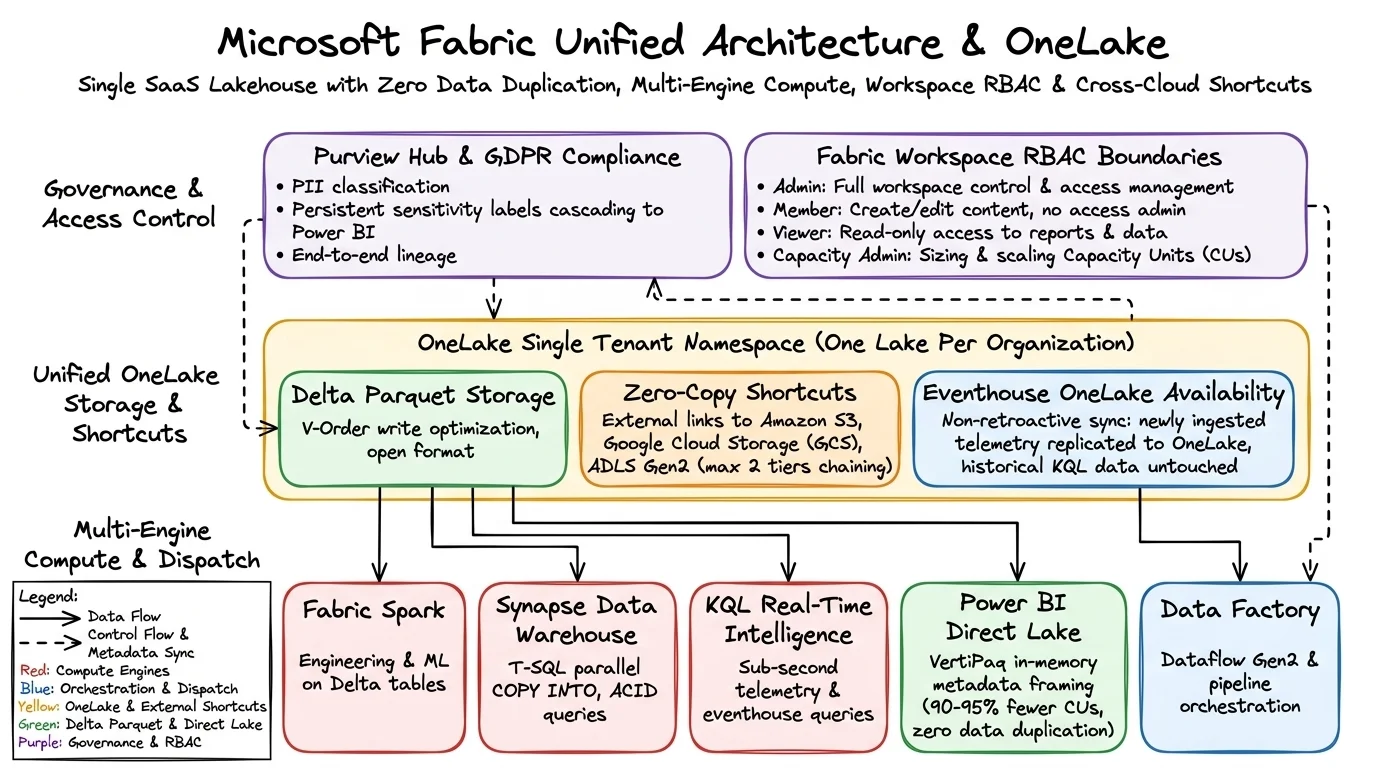
Microsoft Fabric Unified Architecture & OneLake

Single SaaS Lakehouse with Zero Data Duplication, Multi-Engine Compute, and Cross-Cloud Shortcuts

Microsoft Fabric Unified Architecture & OneLake
Architectural Takeaways & Internals:
  • One Tenant = One OneLake: single unified hierarchical namespace automatically provisioned per tenant. Workspaces serve as logical containers and RBAC boundaries, not physical storage accounts. Capacities provide compute resources, not storage silos.
  • OneLake Shortcuts virtualize internal workspace folders and external clouds (Amazon S3, Google Cloud Storage, ADLS Gen2) with zero data copying. Best practice limits chaining to 2 levels maximum to avoid latency and metadata degradation.
  • Eventhouse OneLake Availability: Enabling OneLake availability does NOT retroactively duplicate historical KQL telemetry; only newly ingested data arriving after activation is synchronized to OneLake as Delta Parquet.
  • Unified Governance via Purview Hub: Automated PII discovery, classification, and sensitivity labeling across Lakehouses and Warehouses for GDPR compliance.
#Microsoft Fabric#OneLake#Delta Lake#Direct Lake
Launch Guided Track
More Architecture Blueprints42 available
Power BI Direct Lake Mode & VertiPaq Semantic Engine
Fabric & Power BI

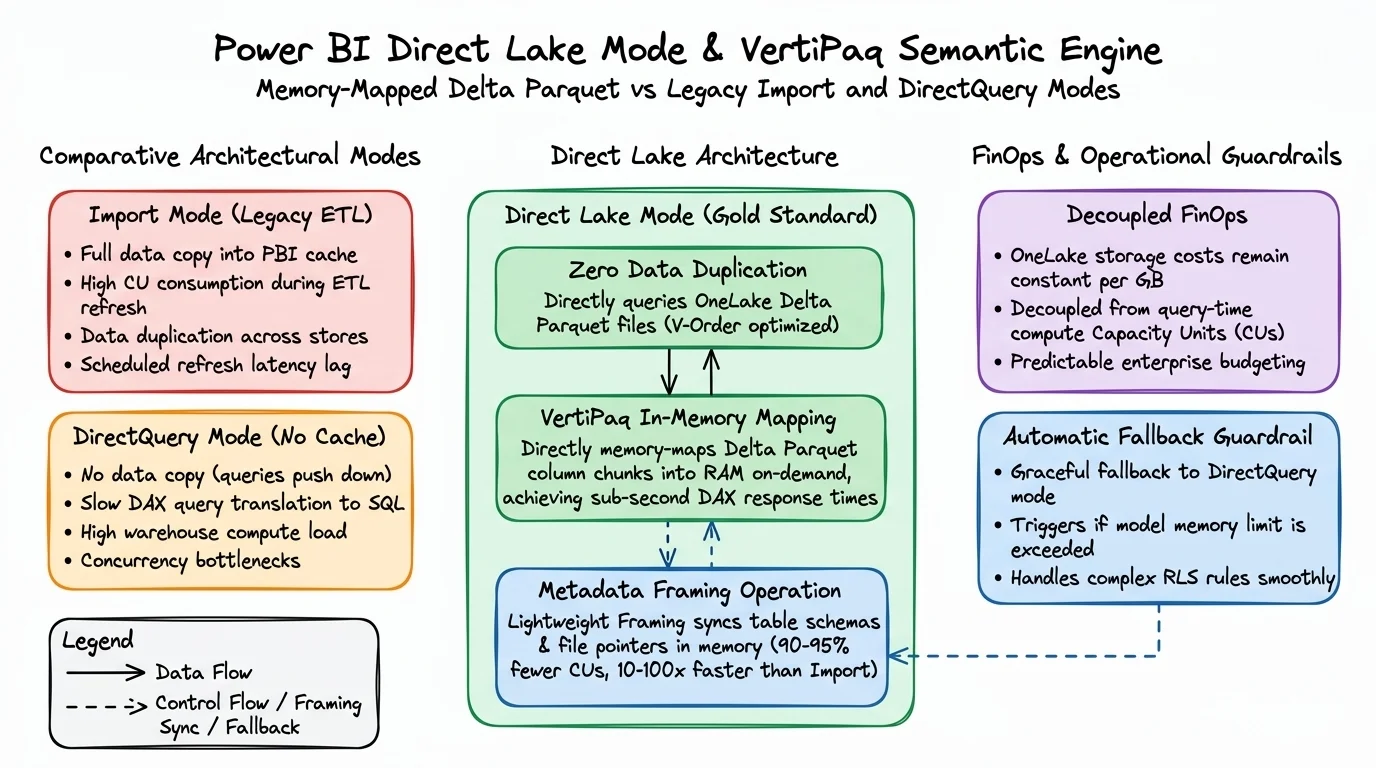
Power BI Direct Lake Mode & VertiPaq Semantic Engine

Memory-Mapped Delta Parquet vs Legacy Import and DirectQuery Modes

Track: Power BI & VertiPaq→
Power BI DAX Engine Mechanics & Context Transition
Fabric & Power BI

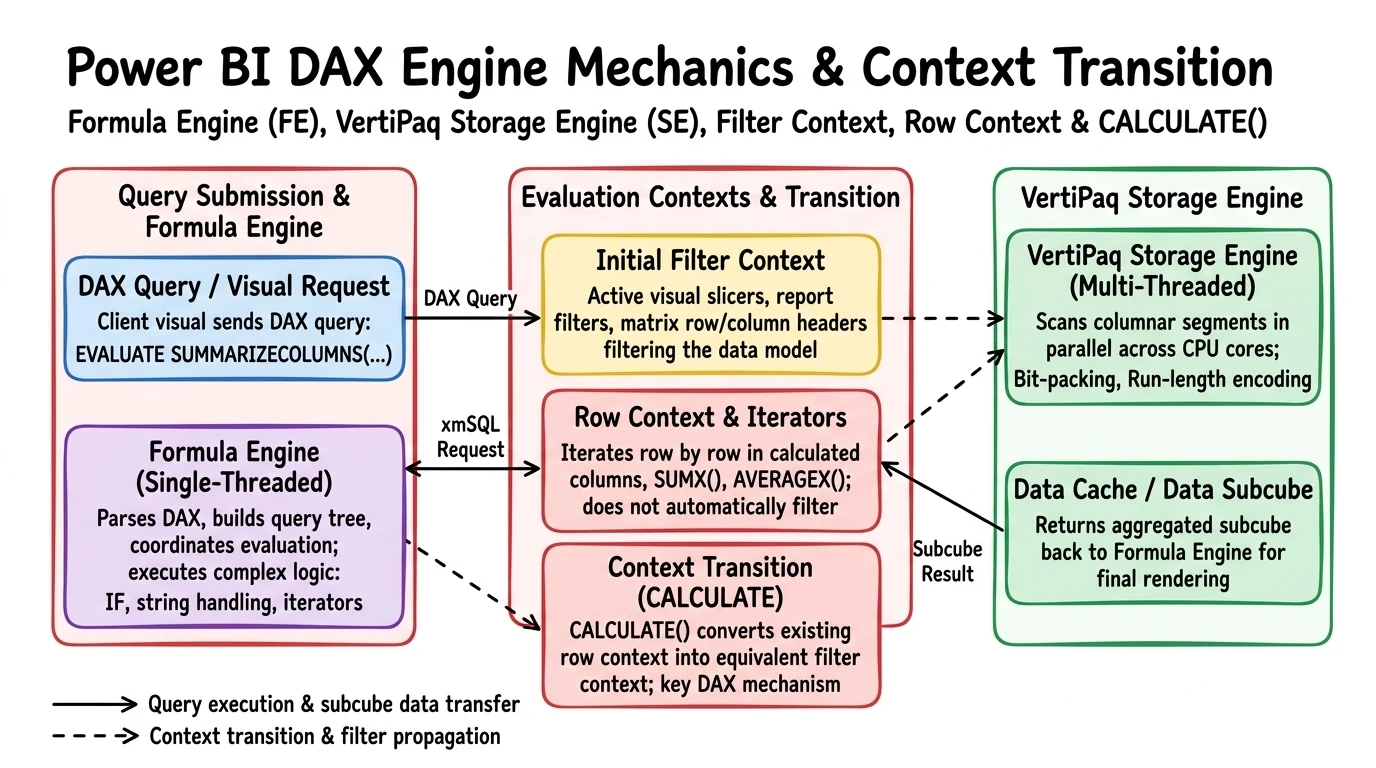
Power BI DAX Engine Mechanics & Context Transition

Formula Engine (FE), VertiPaq Storage Engine (SE), Filter Context, Row Context & CALCULATE()

Track: Power BI & DAX→
Apache Airflow Distributed Production Architecture
Data Pipelines & Ingestion

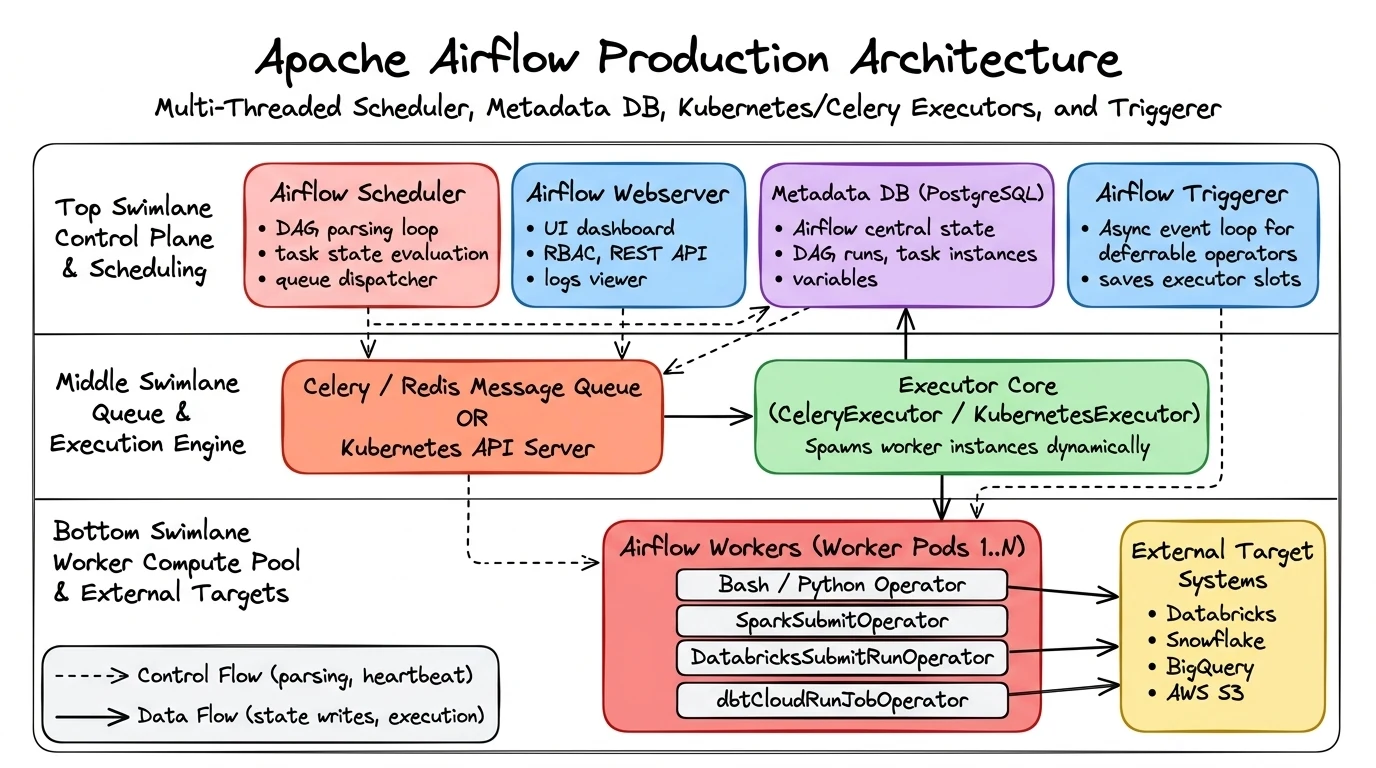
Apache Airflow Distributed Production Architecture

Multi-Threaded Scheduler, Metadata DB, Kubernetes/Celery Executors, and Triggerer

Track: Apache Airflow→
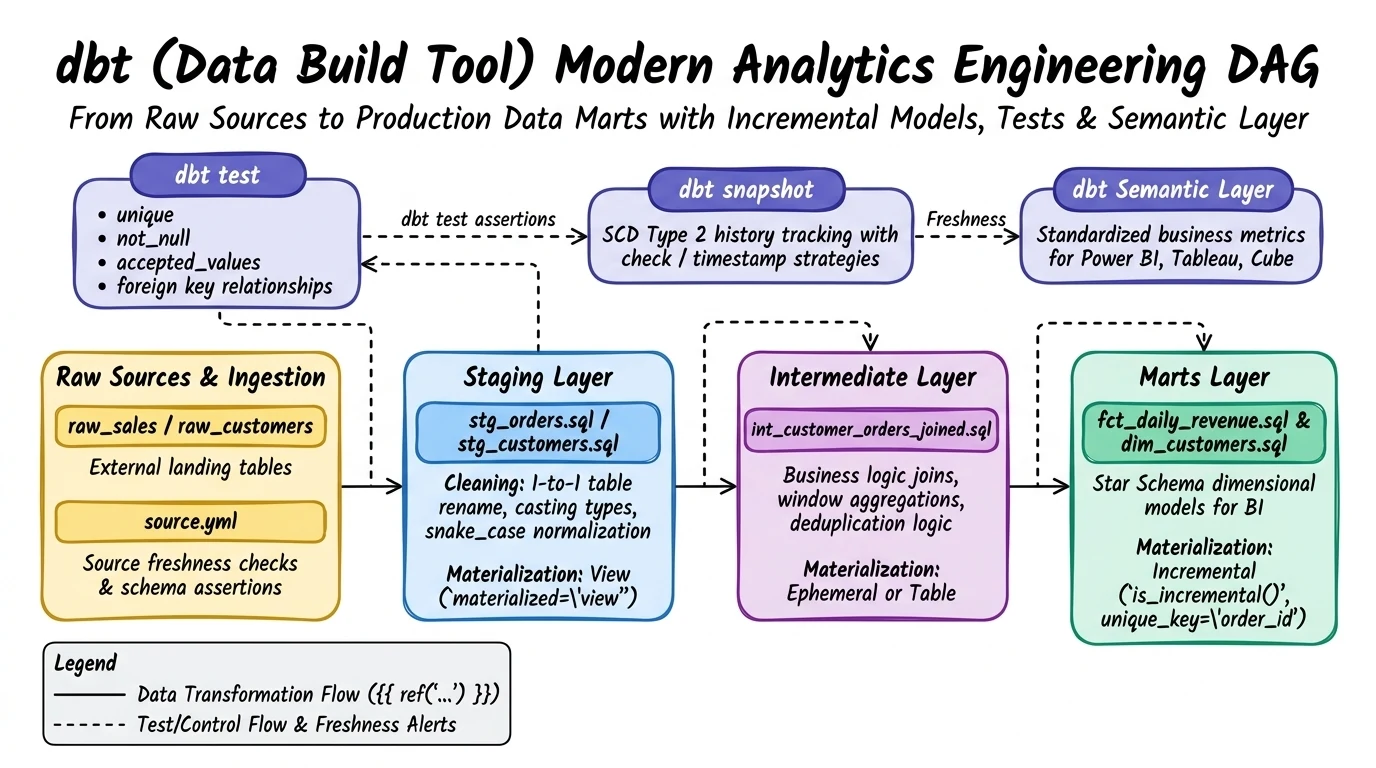
dbt (Data Build Tool) Modern Analytics Engineering DAG
Data Pipelines & Ingestion

dbt (Data Build Tool) Modern Analytics Engineering DAG

From Raw Sources to Production Data Marts with Incremental Models, Tests & Semantic Layer

Track: dbt Modern Stack→
Explore All 13 Guided Tracks with Blueprints

Deep-dive into end-to-end architectures and production implementation guides

Daily Curated Spotlight

Architecture, Code & Simulator of the Day

Data Pipelines & IngestionAdvanced

How do you guarantee strictly idempotent SCD Type 2 dimension updates in a Silver Lakehouse layer?

Pipeline failures and retry attempts often cause duplicate effective-date records or split valid-to timestamps in downstream tables...

Practice Q&As
Code of the DayProduction Pattern

DuckDB Instant Parquet Aggregation Over Cloud Storage

duckdb_remote.py
import duckdb
 
# Query remote S3 Parquet directly without cluster spin-up
con = duckdb.connect()
con.execute("INSTALL httpfs; LOAD httpfs;")
 
df = con.sql("""
SELECT
region,
approx_count_distinct(user_id) AS unique_visitors,
avg(response_ms) AS p50_latency
FROM read_parquet('s3://prod-logs/2026/*/*.parquet')
GROUP BY region
""").df()
DuckDB Query EngineExplore Code Practice
Live Tool of the DayInteractive

Apache Iceberg File Sizing & Compaction Calculator

Model metadata manifest tree bloat, bin-pack target file counts, and commit concurrency limits under continuous streaming ingest.

Target Data File Size:512 MB Parquet
Manifest Pruning Gain:85% Scan Reduction
Launch SimulatorZero install
Verified Question Bank Metrics
Weekly Architect Digest

Level Up from Senior Engineer to Principal Architect

Get curated weekly production blueprints, deep-dive Lakehouse trade-offs, and FAANG interview rubrics delivered directly with zero spam.

100% Free Forever No Spam Guarantee 7,080+ Q&A Archive
Or explore all 12 Learning Paths directly.
Enterprise Architecture Whitepaper & Blueprint

What is a Lakehouse? Modern Lakehouse Architecture Explained

A Data Lakehouse is a modern data management architecture that combines the scalability, flexibility, and cost-efficiency of commodity cloud object storage (Data Lakes) with the ACID transaction guarantees, schema enforcement, fine-grained governance, and high-performance SQL query capabilities of enterprise Data Warehouses.

Historically, enterprises operated dual-system architectures: unstructured data and telemetry were dumped into raw data lakes (e.g., ADLS Gen2, AWS S3), while structured business reporting required fragile, expensive ETL pipelines to copy data into proprietary data warehouses (e.g., Snowflake, Teradata, Synapse Dedicated Pools). The modern Lakehouse Architecture eliminates this redundancy by establishing a single source of truth directly on open table formats like Delta Lake and Apache Iceberg.

System Decomposition

The 5 Core Layers of Modern Lakehouse Architecture

Every production-grade Lakehouse decouples storage, metadata, cataloging, and compute into independent, horizontally scalable tiers.

Layer 1

Cloud Object Storage Tier

Low-cost, highly durable, infinitely scalable object storage acting as the physical substrate. Examples include Azure Data Lake Storage (ADLS Gen2), AWS S3, Google Cloud Storage, and Microsoft OneLake.

OneLakeADLS Gen2AWS S3
Layer 2

Open Table Format & ACID Metadata

Provides transactional integrity (serializable ACID), versioned commit logs, schema enforcement, time travel, and file compaction directly over columnar Parquet files.

Delta Lake 3.xApache IcebergApache Hudi
Layer 3

Unified Catalog & Governance

Single-pane-of-glass metadata management, data lineage, column/row-level security, attribute-based access control (ABAC), and cross-cloud data sharing.

Unity CatalogMicrosoft PurviewApache Polaris
Layer 4

Distributed Compute Engines

Decoupled, stateless execution runtimes optimized for batch ETL, micro-batch streaming, ad-hoc SQL, and AI model training operating over the same storage without copies.

Apache Spark 4.0Databricks PhotonTrino / DuckDB
Layer 5

Consumption & Serving Tier

Zero-copy reporting, Direct Lake semantic models in Power BI, REST endpoints, feature stores for machine learning, and sub-second analytical dashboards.

Power BI Direct LakeDelta SharingMLflow
Deep Practice

Test Lakehouse System Design

Dive into 3,206+ production scenarios, whiteboard blueprints, and failure-mode analysis.

Explore Architecture Hub
Data Quality Lifecycle

The Medallion Architecture: Bronze, Silver & Gold Standard

The Medallion Architecture is the canonical data design pattern used within Lakehouse systems to systematically improve data quality, structure, and performance as data progresses through three logical tiers:

Bronze (Raw Landing)
Append-Only

Raw Ingestion & Historical Archive

  • Raw, unaltered state preserving complete fidelity of source payloads.
  • Supports schema-on-read, JSON/Avro/Kafka streaming, and batch dumps.
  • Enables full historical reprocessing and replayability during pipeline failures.
  • Includes ingestion metadata: timestamp, source file name, and Kafka offset.
Silver (Cleansed & Conformed)
Enriched

Cleaned, Deduplicated & Standardized

  • Deduplication, primary key validation, and schema enforcement applied.
  • Standardized column naming conventions and canonical ISO date/time types.
  • Slowly Changing Dimensions (SCD Type 1 & Type 2) tracking historical changes.
  • Serves ad-hoc self-service exploratory analysis and feature engineering.
Gold (Curated Business Marts)
Star Schema

Dimensional Models & High-Speed BI

  • Kimball star schema architecture: Fact and Conformed Dimension tables.
  • Pre-aggregated metrics, business KPIs, and low-latency reporting models.
  • Optimized with Liquid Clustering or Z-Ordering on primary filter predicates.
  • Power BI Direct Lake mode connects directly to Gold Delta tables in OneLake.
Evaluation & Trade-offs

Lakehouse vs Data Warehouse vs Data Lake: Comparison Matrix

Understand key trade-offs between traditional storage paradigms and modern Lakehouse implementations:

Architectural DimensionTraditional Data LakeEnterprise Data WarehouseModern Data Lakehouse
Storage & Compute CouplingDecoupled (Raw Files)Coupled or Proprietary Managed100% Decoupled (Open Object Storage)
ACID Transaction SupportNone (Prone to dirty reads)Full ACID (Proprietary)Full ACID (via Delta Log / Iceberg Metadata)
File & Storage FormatOpen (CSV, JSON, Parquet)Proprietary Columnar BlocksOpen Apache Parquet + ACID Logs
AI, ML & Streaming SupportHigh (Native Python/Spark)Limited (Requires ETL exports)First-Class (Direct PyTorch/Spark/Python access)
Time Travel & RollbacksManual (Object versioning)Available (Proprietary retention)Standard (SELECT * FROM table TIMESTAMP AS OF)
Vendor Lock-In RiskVery LowExtremely HighZero (Open formats readable by any engine)
Performance Engineering

Key Optimization Techniques Every Lakehouse Architect Must Master

Essential storage engine and query tuning primitives to achieve sub-second execution at petabyte scale:

Small File Problem & Compaction (OPTIMIZE)

Streaming pipelines generate thousands of tiny Parquet files (<10MB), causing metadata explosion and slow directory listings. Lakehouses run periodic bin-packing compaction (e.g. OPTIMIZE table) to coalesce files into optimal 128MB–1GB chunks, dramatically reducing IO overhead.

Liquid Clustering & Multi-Dimensional Z-Ordering

Replaces rigid directory-based partitioning (which suffers from partition skew and over-partitioning). Liquid Clustering dynamically clusters data along multiple columns without rewriting unaffected files, enabling extreme file pruning and data skipping on high-cardinality filters.

Data Governance & Centralized Catalogs

Decoupled architectures require centralized governance. Tools like Databricks Unity Catalog and Microsoft Purview / OneLake enforce unified permissions, row filters, column masking, and end-to-end lineage across all compute engines accessing the storage layer.

Direct Lake Zero-Copy BI Serving

Microsoft Fabric introduced Direct Lake mode for Power BI, which reads Delta Parquet files directly from OneLake storage into the VertiPaq in-memory analytics engine without importing or duplicating data, combining the scale of DirectQuery with the blazing speed of Import mode.